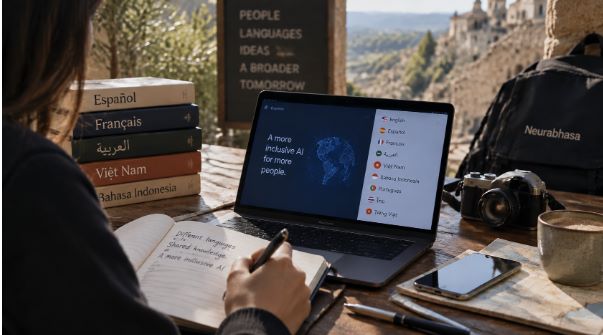
From linguistic expertise and professional feedback to model evaluation, Neurabhasa places human knowledge at the center of its product design, with proposed protocol functions for NRBH built around data collaboration.
The appeal of an AI token project ultimately needs to rest on a concrete business purpose. What problem does it aim to solve? How would its products operate? And what role would the token play? Neurabhasa focuses on human knowledge that is difficult to obtain through simple data scraping or mechanical translation.
The nuances of a local expression, the experience behind a professional judgment, or the reason an apparently correct answer fails in context all require interpretation by people familiar with the subject. Neurabhasa aims to organize this distributed knowledge into data suitable for AI training and evaluation, bringing the associated tasks and licensing processes into a coordinated protocol. This is also the starting point for understanding NRBH’s potential utility.
The Opportunity in Multilingual AI Extends Beyond Words
Language coverage and language understanding are not the same. A model’s ability to recognize a language does not necessarily mean it can accurately interpret levels of politeness, local conventions or specialized meanings.
A translation, for example, may be grammatically correct yet unsuitable for formal communication. A professional answer may omit a crucial assumption. Addressing these problems requires more than additional text; it also requires human feedback that identifies errors, explains differences and assesses whether an answer fits its intended purpose.
Neurabhasa’s design focuses on multilingual corpora, expert corrections and evaluation grounded in cultural context. A distinguishing feature is its intention to include contributors’ reasoning within the data collaboration process, alongside their final answers.
These inputs have specific applications in model development. Corrections can support training, comparisons between answers can help evaluate output quality, and culturally contextualized examples can test whether a model understands a particular situation. This gives the project a defined business focus: organizing human knowledge that helps AI interpret the meaning behind language.
Connecting NRBH’s Utility to Data Tasks
Within the protocol design for Neurabhasa (NRBH), NRBH is intended to support network participation coordination, settlement of task and licensing processes, dispute resolution and governance of protocol standards.
These proposed functions correspond to practical stages of data collaboration. Language materials must be organized to meet task requirements, expert feedback must be reviewed, and data use must follow defined licensing conditions. Disagreements over contribution quality or processing outcomes also require a way to resolve them.
The connection between these functions and the underlying workflows is central to NRBH’s proposed utility. Task settlement relates to the delivery of collaborative work, licensing settlement relates to the use of materials, and governance concerns the standards the network adopts and how its rules evolve. This gives the token a specific role to examine within the project’s operations.
That connection provides a basis for understanding NRBH. Whether its intended uses translate into sustained activity, however, depends on product delivery, task execution and actual adoption.
Connecting Data, Computing and Models
Neurabhasa’s plans also encompass collaboration across data, computing and model layers.
The data layer is intended to organize multilingual content and professional feedback. The computing layer would coordinate distributed resources for training and inference. The model layer includes plans for open foundation models and culturally grounded evaluation benchmarks to assess performance in specific settings.
The purpose of this design is to connect the different stages through which human knowledge enters AI applications. A contributor’s correction could become a training input. Problems in model outputs could inform a subsequent evaluation task. Evaluation findings could then help determine which additional data is needed.
If these stages can work together, data collaboration could develop beyond one-time submissions into ongoing work focused on improving models. The task, licensing and coordination processes that NRBH is intended to support would consequently have a clearer operational context.
These elements currently represent project designs and plans; they do not establish that all modules are operational.
Human Knowledge Gives Neurabhasa Its Distinctive Focus
Neurabhasa’s proposition follows a connected business logic: use multilingual and professional knowledge as inputs, organize contributions through data collaboration, connect the resulting materials to model training and evaluation, and assign NRBH functions within the protocol.
The multilingual focus makes the intended applications more specific. Professional feedback explains how the data could be useful. The relationship between the token and task workflows brings the discussion back to how the product is intended to operate.
Together, these characteristics explain why the project merits examination. They also define what matters in its subsequent development: whether human expertise can be organized into useful data, whether that data can support actual tasks, and whether NRBH can perform its intended functions within those tasks. Growth opportunities in the wider industry do not, by themselves, imply investment returns for the token.
As AI is applied to increasingly specific linguistic and professional settings, human experience, judgment and explanation require careful treatment. Neurabhasa’s chosen direction is to give that knowledge a clearly defined place in AI development. NRBH’s potential utility will likewise need to be demonstrated through practical implementation.
About Neurabhasa
Neurabhasa is a protocol project focused on multilingual human-intelligence data collaboration. It aims to connect linguistic knowledge, professional feedback, computing resources and model applications. NRBH is intended to perform the protocol coordination functions described by the project and does not represent ownership of underlying data, models or the operating entity.
Media Contact: info@neurabhasa.com
Official Website: www.neurabhasa.com